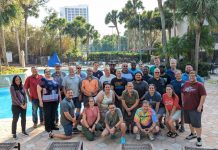
New APSE president Dan Spears gave his induction speech Saturday night during the Awards Dinner of the annual APSE Summer Conference in Charlotte, N.C. Here’s his speech, in its entirety.
As a senior in college, with about five weeks before graduation, I – much to my delight, and the greater delight of my parents – got my first in-person professional job interview. In order to get to Anderson, South Carolina, a three-hour drive from northern Missouri to Kansas City for an early, early flight was required in the midst of the school year.
That morning, both I and the friend who was driving me to the airport overslept. After a mad dash out of the house, we tested the speed limit on my 1985 Chevy Celebrity, broke a couple of laws, and I made my flight on time. Thank goodness we didn’t have TSA yet.
Flying from 40 degrees in Kirksville to an 80-degree early April day in Greenville, South Carolina, meant I already was sweltering when I stepped into the terminal and met Randy Beard, the Anderson sports editor, standing at the gate holding an Anderson Independent-Mail in his hand, not knowing me from any other person walking off that plane.
How very James Bond espionage, I thought.
Driving back to Anderson with Randy, we were supposed to first go to my hotel to check in. A chance for me to get a shower, change into the shirt and tie in my bag and be presentable for my first big moment as a pro.
Not too long after we got on Interstate 85, however, Randy informed me that we were going straight to the newsroom to meet the publisher and everyone else. The internal panic meter was pegged. Baseball hat, disheveled, sweated-through, long-sleeve shirt and jeans which I had also worn the day before was gonna be quite the first impression.
Me at 21 thinks the next part was calm, cool and collected. Me at 51 is certain it was not.
Either way, I reach into the middle row of his minivan, open my bag, find my bathroom kit, pull out an electric razor, turn back around, pull down the sun visor and start shaving in the car while he’s talking to me.
We get to the newsroom, the news editor is clearly taken aback, and not just because it was a Florida Marlins hat in Braves country. This is a “full dress” newsroom, welcome to the South in the mid-1990s. Shirt and tie on every man. Every woman in a dress. After introductions and the newsroom budget meeting, the executive editor took me to his office and offered me a Diet Coke. T. Wayne Mitchell, wherever you are today, you saved my life.
I did well in the interview. I didn’t get the job.
But a week later, Randy called me again. The other guy was out, and I was now who they wanted. I said yes.
A decade later, in May 2005, I walked to the first tee at Augusta National in the midst of a war.
My driver and 3-wood and I have had a hate-hate relationship for decades, and we were in the middle of an extended bad patch at that moment. The 3-wood was banished to the bedroom closet; the driver was solely in the bag for the two-club-length advantage it provided for dropped shots. I’d been playing nothing but irons and a putter for nearly a year.
Glen Greenspan, then the media relations director for the Masters, was flabbergasted, and a bit offended, when I told him this on the first tee. Out of respect to Glen, and to not anger the golf gods, I took out driver on the opening hole and proceeded to hit my ball about 60 yards, at a 45 degree angle to the left, into the ninth fairway.
“Hit the 3 iron,” he said with a laugh. I shot 81.
I was in the first group to lose the famous car-park lottery at Bethpage Black ahead of the first U.S. Open there; legendary golf writer Ron Sirak wrote a front-page story for the Hartford Courant about me and my roommate’s failure. The Red Course, by the way, is terrific.
I ran my first marathon after I lost a bet with my best friend. I ran my second because I knew I had mailed in the first one. The 13 after that are completely my own fault.
When I finally decided to run for APSE office as third vice president, I lost. Then Justin Pelletier big-timed it to Boston and I was asked to take over. When I ran for second VP, I lost. I ran again and … well, here I am.
I tell you these stories because I’ve rarely been the first, or the best. My methods might seem a little unorthodox. But I haven’t given up, and being proud of who I am and how I do things turned out to serve me well, once I fully embraced it.
Over the past 14 months, my job has put me in front of dozens of reporters and editors in big towns and small cities across the country. Grizzled veterans to 21-year-olds right out of college. They are amazing people. The knowledge they have shared with me in that short amount of time has gone beyond my expectations.
I always knew it, but it proved that far too many people in our industry have been abandoned in recent years. It’s not the fault of anyone in this room, it’s merely the truth we’re living in. I’ve heard the stories first hand that have led to too many stories of burnout, of being tired all the time, of having the notion that they have to do everything.
Worst of all, they felt alone. And I know that feeling far too well.
Two years ago, I said you should vote for me as second vice president of this organization because of my belief in togetherness and how we as editors must help our teams create a good head space to succeed. Because that was how I found my strength professionally, even though I wasn’t there personally yet.
In Anderson, South Carolina, I grew up among a newsroom full of young journalists given wide latitude to experiment, fail and succeed. At 3, 4 and 5 in the morning, and sometimes later, talking about life on our own for the first time while doing amazing work in tough moments – including racing to the back of the building and yelling ‘Stop the press,’ because of the Atlanta Olympic bombing. Yes, I really did that.
In Hagerstown, Maryland, I was molded by older co-workers whose sharp wit forced me to be prepared for any moment. Bob Parasiliti, Mark Keller and Al Ditzel were relentless, and so good at their jobs. They taught me how to be a pro. Where my boss, Ron Somers, hoodwinked our poor clerk into believing it was called the agate page from the Italian word ‘agate,’ which meant little type.
In Augusta, Georgia, I learned planning can’t start early enough, and that ideas should flow like the parking-lot drinks on the Sunday night of the Masters after the final edition was put to bed. Where John Boyette ran the sports show with self-deprecating humor and an unparalleled knowledge base, and John Gogick was his natural foil.
In Wilmington, where, finally tasked with a team to call my own, I hoped I took the best from all those unconventional places and people, and let my reporters grow, learn and tell stories in an atmosphere where everyone’s opinion was valid, but you better be quick with a comeback.
And the Google Hangouts during my time as third vice president made me remember how great any organization can be when it works together.
In this moment, we as sports journalists need that more than ever.
We’ve been knocked down by things out of our control. We’ve tripped ourselves here and there, too. We have to get back up, know what we’ll do differently the next time. I hope what you’ve learned this week is the first step in that process.
Yet once we walk out these doors, maintaining that feeling of togetherness is difficult. We’re spread out more than 3,000 miles, worried about more people and places than we have before.
We – this core group of editors, reporters and friends of journalism – persevere together, but how will we truly grow as an organization? How do we dynamically show people what we do, that we are far more than contest announcements and Zoom meetings? How do we tell people: APSE makes me great at my job, and do it boldly and at every opportunity?
I have some ideas. I know all of you do too. I need you to share them with me. And Paul, Perryn and Tony. And Naila and Lisa and the foundation.
The great news, though, is that we will have the biggest podium we’ve ever had over the next four years in which to do it: Our efforts will be seen by the world. What we do – and how we tell people we did it – can define us as an organization.
We have a Summer Olympics in a month. In two years, a North American World Cup. Another Summer Olympics in our country two years after that (Good luck, Iliana). A college athletics landscape that will look nothing like it does today. The exponential growth of women’s sports will continue.
The demand for sports journalism is about to hit critical mass. Following the money, opening our industry to everyone … it’s all coming. Are we ready? Will we be proud of the stories we share, the names we put in the headlines, the truths we tell?
And that’s where the personal part comes in. Because for all those good things that professionally over the years together with my co-workers, the truth for me was not fully being told.
I was alone as a gay man who got comfortable in the closet for too long. Telling my truth came slowly, hesitantly.
I can remember meeting my first fellow gay sports writer nearly 25 years ago. We were both excited, and terrified. Living in rural, conservative parts of the country, we wondered: What if someone outed us? Would we lose our jobs? Would we be arrested because we worked with male high school students? We commiserated over everything, of how unsure we were about everything even though we both loved what we did for a living.
Those conversations have never left me. I still worry that any of those things could happen to a young, gay sportswriter today.
I took my closet door off its last bracket 18 months ago. Thirty-some years is a long time for a process, but sometimes that’s how long it takes. Apparently, I’m the first out LGBTQ+ president of our organization. I completely believe it, and I’m also completely surprised it’s me.
I hope that I can use this space to be a role model, like other queer editors and reporters from the present and past, people that I’ve read and admired. People that have done far more than I to defend those in the margins, and done things their way, proudly. In this Pride month, I hope they see that I am ready
to carry that torch.
In accepting the Jack Berninger Award yesterday, Bill Eichenberger said that APSE was his tribe. I, too, am proud that APSE is my professional tribe, as well as a part of a personal tribe that is finally full.
I have been thankful for a long time to be a member of this organization. You all have inspired me, pushed me, given me knowledge.
You are trusting me with this role – and it’s a true privilege.
Thank you.